
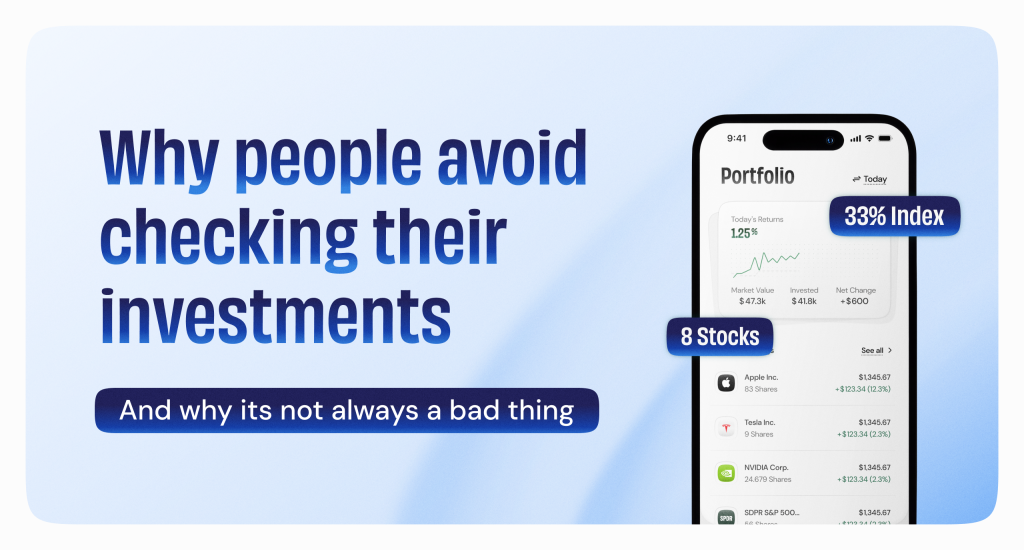
Why less monitoring can lead to better investments
- Srishti Narang
- January 24, 2026
- 10:29 am
Checking your bank balance feels normal.
Checking your investments often doesn’t.
For many people, there’s a quiet discomfort around opening an investment app or statement — even when nothing dramatic has happened. This behavior is often framed as avoidance or irresponsibility.
In reality, it’s far more nuanced.
Behavioral finance shows that how often we look at investments can materially affect how we behave — and how well we do over time.
The Common Misunderstanding
The prevailing assumption is simple:
“Engaged investors check their investments frequently.”
But decades of research suggest the opposite can often be true.
Frequent checking doesn’t necessarily lead to better decisions.
In many cases, it leads to more emotional ones.
The Psychology Behind Investment Avoidance
Human brains are not designed to process constant probabilistic feedback.
Behavioral economists, including Daniel Kahneman, have shown that people experience losses more intensely than gains — a concept known as loss aversion.
When applied to investing:
- Small short-term losses feel disproportionately painful
- Even normal market fluctuations can trigger stress
- Stress increases the likelihood of reactive decisions
Avoiding frequent checks can therefore be a protective response — not apathy.
Myopic Loss Aversion: A Key Concept
A related idea in behavioral finance is myopic loss aversion.
It describes what happens when:
- Long-term investments are evaluated too frequently
- Short-term volatility is mistaken for long-term risk
When people see fluctuations too often, they tend to:
- Overestimate risk
- Underestimate long-term returns
- Make premature changes
This helps explain why some investors choose to look less often.
What the Data Shows
Multiple long-running studies on investor behavior show a consistent pattern:
- Investors who trade or react more frequently tend to underperform
- The underperformance is driven primarily by behavior, not asset choice
- Timing decisions — often triggered by short-term movements — account for much of the gap
In other words, attention itself can become a source of risk.
When Avoidance Is Rational- And When It Isn’t
Avoiding investment checks can be constructive when:
- A long-term strategy is already in place
- The investor understands the expected volatility
- Decisions don’t depend on short-term movements
It becomes problematic when:
- There is no clarity on what the money is doing
- Risks are not understood
- Avoidance replaces awareness entirely
The distinction is not checking vs not checking —
it’s intentional distance vs unexamined neglect.
Why This Matters More Today
Modern investing platforms:
- Update prices in real time
- Use notifications, alerts, and visual cues
- Encourage constant engagement
This environment amplifies short-term noise.
For many people, disengaging from constant updates is a way to preserve:
- Emotional balance
- Long-term discipline
- Decision quality
Clarity Reduces the Need for Constant Checking
Behavioral research consistently shows that people are more comfortable stepping back when they:
- Understand how their money is invested
- Know what outcomes to expect
- Can explain the strategy in simple terms
When clarity is high, attention can be lower without increasing risk.
This is why education and structure matter more than vigilance.
How This Perspective Shapes Sav
At Sav, we think about investor behavior before features.
Not in terms of encouraging less awareness —
but in terms of reducing unnecessary emotional triggers.
If systems are designed so users can:
- Understand what their money is doing
- Know why short-term fluctuations occur
- Trust the structure they’re participating in
Then constant monitoring becomes less necessary — and often less helpful.
FAQs
Sav is a money-management app, allowing you to stick to your money goals, plan for the future, and spend confidently in the present.
Your Sav card helps you meet your goals – just connect your bank account, top up your Sav card, choose goals you would like to set aside money for, and apply rules that automatically allocate funds toward your goals. The money set aside for your goals is safe. It is always available on your prepaid card and held with our partner financial institutions licensed by the CB UAE.
You can use your Sav card to get additional rewards and cashbacks while spending. Check out our offer page to find the latest deals and promotions.
No, ‘Sav Technologies Limited’ is a technology company registered in the Dubai International Financial Centre, Dubai, UAE, with registration number # 5474. Through our banking partnership with Mashreq Bank, VISA and NymCard, we provide VISA prepaid cards.
No, Sav does not issue any bank accounts. Instead, Sav offers prepaid Visa cards issued by our partner bank, Mashreq Bank PSC, pursuant to their license from Visa. The money in your savings goals is always held with our partner bank in your individual Sav Card.
At Sav, we do not issue any bank account. It’s a prepaid Visa card.
Share article