
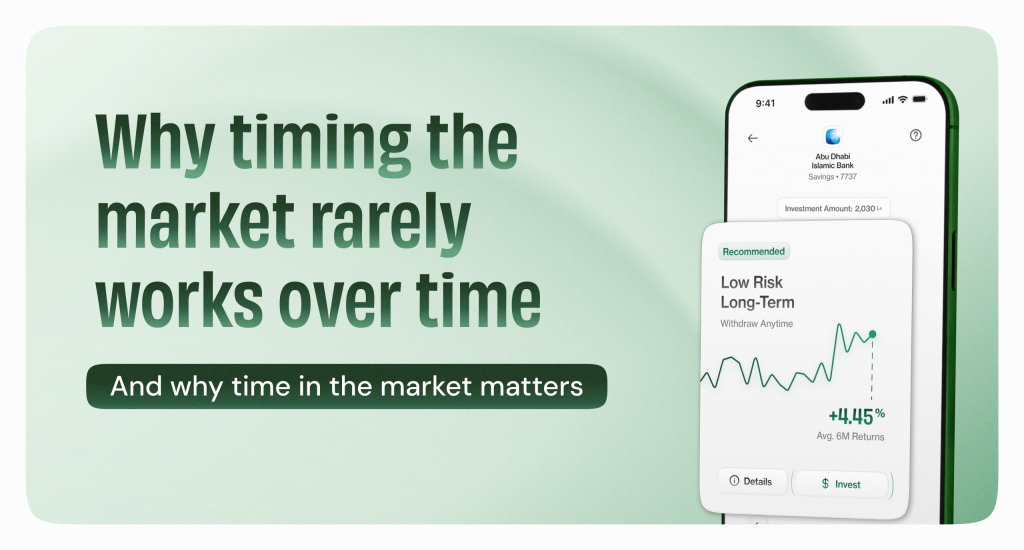
Why less monitoring can lead to better investments
- Srishti Narang
- January 24, 2026
- 10:41 am
Trying to “time the market” is one of the most persistent ideas in investing.
The logic feels intuitive:
wait for the right moment, buy low, sell high, and avoid losses along the way.
Yet decades of market data show a consistent pattern:
👉 Market timing is one of the least reliable ways to improve long-term outcomes.
Market timing is the attempt to:
- Enter markets at low points
- Exit before downturns
- Re-enter before recoveries
To succeed, an investor must consistently answer two difficult questions:
- When to get out
- When to get back in
Getting either wrong has long-term consequences.
The Structural Problem With Market Timing
Financial markets do not distribute returns evenly over time.
Research published by institutions such as Vanguard Group and analysis frequently cited by JPMorgan Chase shows that:
- A small number of trading days account for a disproportionately large share of long-term returns
- Missing just a handful of strong market periods can materially reduce outcomes
- Those periods are impossible to predict consistently in advance
This creates a structural asymmetry:
You can miss many average days without much impact,
but missing a few strong days can permanently change results.
What the Data Shows
Long-term market studies consistently find that:
- Investors who stay invested capture more of the market’s upside
- Investors who exit and re-enter frequently tend to miss key recovery periods
- The cost of being “out” at the wrong time often exceeds the benefit of avoiding downturns
In other words, absence matters more than precision.
Why Market Timing Feels So Compelling
If timing is so unreliable, why does it remain popular?
Behavioral finance offers a clear explanation.
Timing provides:
- A sense of control
- A feeling of action during uncertainty
- Relief from short-term volatility
But this sense of control is often psychological, not statistical.
Markets reward exposure over time, not confidence in predictions.
The Behavioral Cost of Getting Timing Wrong
Market timing doesn’t fail because people lack intelligence.
It fails because:
- Humans are loss-averse
- Short-term volatility feels more important than long-term probability
- Fear and relief drive decisions more than expected value
This leads to a common pattern:
- Exit after declines
- Re-enter after recoveries
- Lock in underperformance over time
Time in the Market vs Timing the Market
The difference between the two approaches is subtle but critical.
Timing the market focuses on:
- Predicting short-term movements
- Making frequent decisions
- Reducing discomfort
Time in the market focuses on:
- Remaining consistently exposed
- Accepting short-term volatility
- Letting compounding work
The second approach aligns better with how markets actually generate returns.
Why This Matters for Long-Term Investors
For long-term goals — retirement, wealth accumulation, financial independence — outcomes are driven less by:
- Entry price
- Tactical brilliance
- Market forecasts
And more by:
- Staying invested
- Avoiding unnecessary exits
- Letting time do the compounding
This is not a call for passivity.
It’s a call for realism.
How This Insight Shapes Sav
At Sav, this understanding of market structure and human behavior informs how systems are designed.
Not to eliminate risk —
but to reduce the number of decisions that depend on short-term emotion.
If staying invested is more important than predicting markets,
then design should support consistency over control.
FAQs
Sav is a money-management app, allowing you to stick to your money goals, plan for the future, and spend confidently in the present.
Your Sav card helps you meet your goals – just connect your bank account, top up your Sav card, choose goals you would like to set aside money for, and apply rules that automatically allocate funds toward your goals. The money set aside for your goals is safe. It is always available on your prepaid card and held with our partner financial institutions licensed by the CB UAE.
You can use your Sav card to get additional rewards and cashbacks while spending. Check out our offer page to find the latest deals and promotions.
No, ‘Sav Technologies Limited’ is a technology company registered in the Dubai International Financial Centre, Dubai, UAE, with registration number # 5474. Through our banking partnership with Mashreq Bank, VISA and NymCard, we provide VISA prepaid cards.
No, Sav does not issue any bank accounts. Instead, Sav offers prepaid Visa cards issued by our partner bank, Mashreq Bank PSC, pursuant to their license from Visa. The money in your savings goals is always held with our partner bank in your individual Sav Card.
At Sav, we do not issue any bank account. It’s a prepaid Visa card.
Share article