
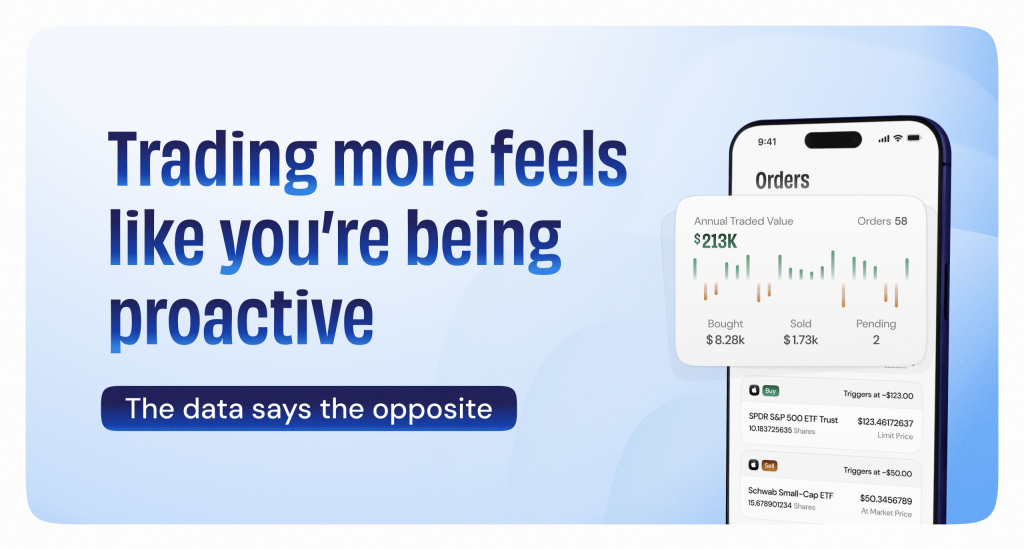
Why trading often usually hurts returns?
More activity feels like progress.
In investing, it often isn’t.
Across decades of market data and behavioral research, one pattern shows up repeatedly:
👉 Investors who trade more frequently tend to earn less over time.
This article explains why — without judgment, jargon, or hype.
What Is Overtrading?
Overtrading refers to making frequent buy and sell decisions in an attempt to improve returns, reduce risk, or respond to short-term market movements.
It often shows up as:
- Reacting to news or price movements
- Constant portfolio “optimisation”
- Switching strategies frequently
- Trying to avoid short-term losses
The intention is rational.
The outcome usually isn’t.
What the Data Shows
Multiple long-running studies on investor behavior reach the same conclusion.
Research frequently cited by institutions like DALBAR and asset managers such as Vanguard Group shows that:
- Individual investors consistently underperform the investments they hold
- The gap is driven largely by timing decisions and trading behavior
- Higher turnover correlates with lower long-term returns
The issue isn’t market access.
It’s what people do with that access.
Why Trading Feels Productive
Overtrading persists because it satisfies several psychological needs:
- Control: Acting feels better than waiting
- Relief: Selling reduces short-term anxiety
- Narrative: Each trade feels like a rational story
Behavioral finance explains this through concepts like:
- Loss aversion (losses feel worse than gains feel good)
- Action bias (preferring action over inaction during uncertainty)
Unfortunately, markets don’t reward emotional relief.
They reward patience and exposure.
The Hidden Costs of Frequent Trading
Overtrading hurts returns in several quiet ways:
- Timing errors: Selling after declines and buying after recoveries locks in underperformance.
- Compounding interruptions: Every exit breaks the compounding process.
- Emotional feedback loops: Short-term noise becomes a trigger for decisions.
- Friction costs: Even low visible fees add up when activity is high.
None of these appear dramatic in isolation.
Together, they materially change outcomes.
Why “Being Active” Is Not the Same as Being Effective
There’s a common belief that:
“If I’m paying attention, I’ll do better.”
But evidence suggests the opposite.
Long-term outcomes improve when:
- Fewer decisions are required
- Systems run without constant intervention
- Short-term volatility is allowed to pass
Effectiveness in investing is about decision quality, not decision quantity.
The UAE Context: Why Overtrading Is Tempting
In the UAE, several factors increase the temptation to overtrade:
- High smartphone usage and real-time notifications
- Global news exposure across time zones
- Easy access to trading platforms
- A strong culture of market discussion
These increase information, not necessarily insight.
More information without structure often leads to more action — not better action.
Doing Less, Deliberately
Avoiding overtrading doesn’t mean disengaging completely.
It means:
- Defining a strategy in advance
- Accepting normal volatility
- Reducing decisions that depend on short-term emotion
The goal is not inactivity.
It’s intentional restraint.
How This Thinking Shapes Sav
At Sav, behavioral research strongly influences design choices.
If frequent decisions tend to hurt outcomes,
then systems should aim to:
- Reduce unnecessary triggers
- Emphasise clarity over constant updates
- Support consistency rather than activity
Better outcomes often come from removing decisions — not adding them.
FAQs
Sav is a money-management app, allowing you to stick to your money goals, plan for the future, and spend confidently in the present.
Your Sav card helps you meet your goals – just connect your bank account, top up your Sav card, choose goals you would like to set aside money for, and apply rules that automatically allocate funds toward your goals. The money set aside for your goals is safe. It is always available on your prepaid card and held with our partner financial institutions licensed by the CB UAE.
You can use your Sav card to get additional rewards and cashbacks while spending. Check out our offer page to find the latest deals and promotions.
2. Is Sav a bank?
No, ‘Sav Technologies Limited’ is a technology company registered in the Dubai International Financial Centre, Dubai, UAE, with registration number # 5474. Through our banking partnership with Mashreq Bank, VISA and NymCard, we provide VISA prepaid cards.
3. Does Sav issue bank accounts?
No, Sav does not issue any bank accounts. Instead, Sav offers prepaid Visa cards issued by our partner bank, Mashreq Bank PSC, pursuant to their license from Visa. The money in your savings goals is always held with our partner bank in your individual Sav Card.
4. How is my Mashreq account different to the Sav account?
At Sav, we do not issue any bank account. It’s a prepaid Visa card.
Share article
Instagram
Linkedin
Facebook-square
Twitter-square