
EN
AR
Product
Company
Smart Investing
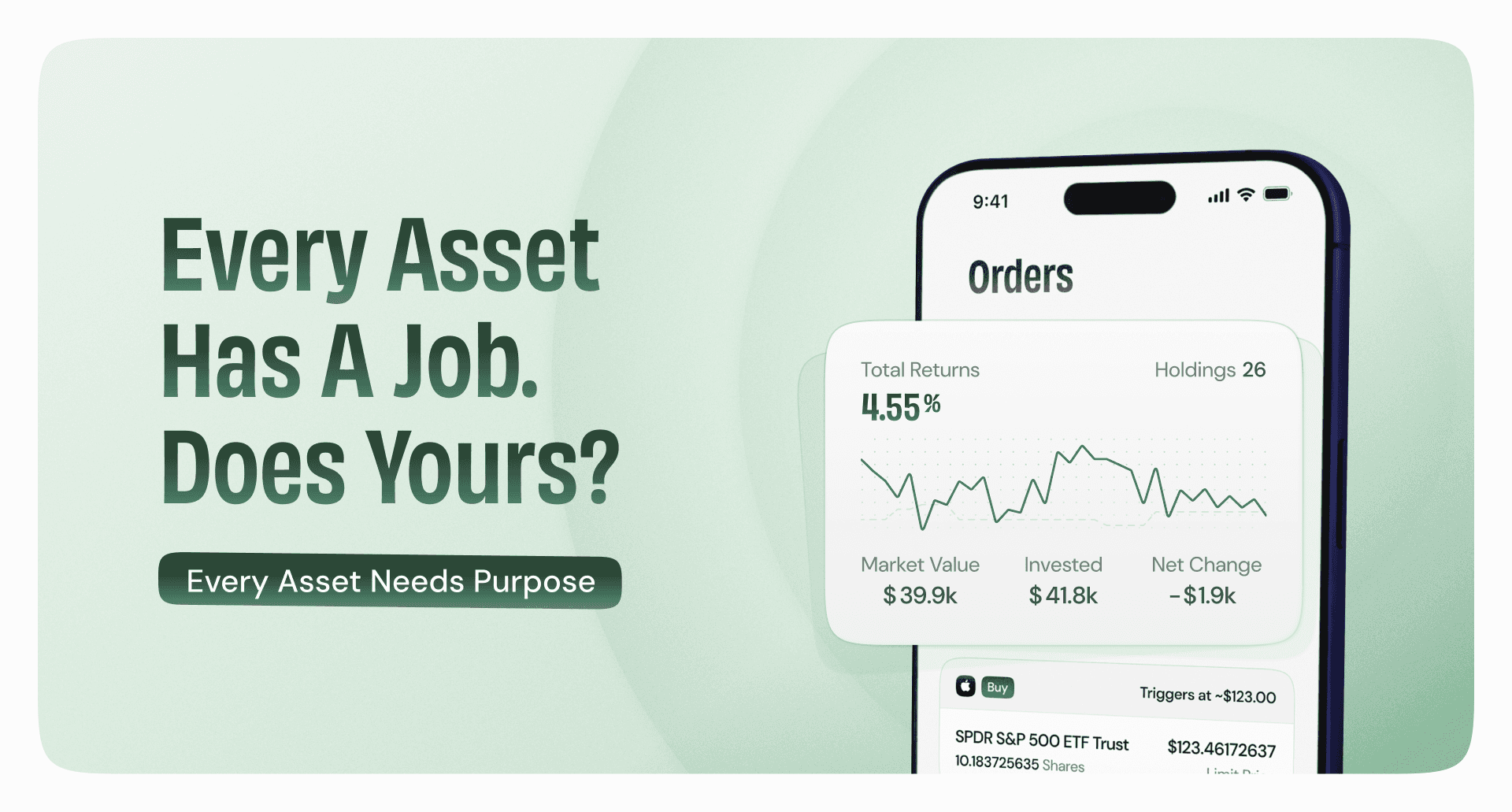
Every Asset Has a Job: How to Build a Smarter Investment Portfolio
Every Asset Has a Job: How to Build a Smarter Investment Portfolio
Here's what's worth your attention:
High income can accelerate wealth creation, but it does not automatically lead to better investment outcomes. This blog explores how overconfidence, excessive trading, concentration, market timing, high fees and lifestyle inflation can affect the portfolios of high earners, and how a disciplined, diversified approach can help protect long-term wealth.
Ask an investor why they own a particular asset and the answer is usually straightforward. It has performed well, someone recommended it, it feels safer, or they believe its price will rise. These explanations may describe why an investment was purchased, but they do not necessarily explain what role it plays within the wider portfolio.
A more useful question is: What job is this asset supposed to perform?
An investment may be held to generate long-term growth, provide liquidity, produce income, preserve capital, reduce portfolio volatility, diversify an existing concentration or provide flexibility when market conditions change. Once each major allocation has a defined purpose, portfolio construction becomes more deliberate. You are no longer simply collecting investments. You are building a structure designed around your financial objectives, time horizon and tolerance for risk.
This distinction becomes particularly relevant for UAE investors, whose financial wealth may already span property, business interests, cash, gold, international investments and employment income.
A portfolio is therefore more than a collection of assets. It is a system in which different investments perform different functions.
The Portfolio Should Be Designed Around Purpose, Not Products
Consider an investor with AED 2 million who owns global ETFs, individual stocks, bonds, gold, property, cash and private investments. At first glance, this may appear well diversified because it contains several different types of assets.
However, the number of investments does not tell you whether the portfolio is genuinely diversified or whether each allocation serves a meaningful purpose.
Suppose the portfolio consists of:
65% equities
15% property
10% cash
5% gold
5% individual speculative investments
The investor has multiple asset classes, but the portfolio may still be heavily dependent on a few underlying sources of return and risk.
The more important questions are whether there is sufficient liquidity for upcoming needs, whether the portfolio is exposed too heavily to one sector, geography or economic outcome, and whether the level of risk is appropriate for the investor's time horizon.
This is broadly consistent with the way Vanguard approaches asset allocation, where the mix of stocks, bonds and cash is a key consideration in determining a portfolio's long-term characteristics.
The objective, therefore, is not to own as many different assets as possible. It is to understand what each allocation contributes to the portfolio.
Job 1: Equities Are Usually the Growth Engine
For many long-term portfolios, equities are primarily held for capital growth. When you own shares of a company, your investment participates in the future performance of that business. Companies can grow revenue, expand into new markets, increase profitability and reinvest earnings into future growth.
Over sufficiently long periods, this exposure to businesses and economic expansion can make equities an important component of wealth creation.
The trade-off is volatility. Equity prices can decline significantly over shorter periods, sometimes even when the long-term investment thesis remains intact. This makes time horizon an important part of the decision.
An investor with a 20-year horizon may have greater capacity to tolerate a significant temporary decline. Someone who needs the same money next year has considerably less room for market volatility.
The question, therefore, is not simply whether equities are risky. It is whether equities are appropriate for the job that particular capital needs to perform.
For UAE investors building long-term exposure to global markets, Sav Wealth provides access to US stocks and ETFs, including fractional investing. This allows investors to allocate specific amounts across companies and funds rather than having their portfolio structure dictated by the price of a whole share.
Scenario 1: Two Investors, Same Portfolio
Consider two UAE investors, each with AED 3 million.
Investor A expects to use AED 1 million for a property purchase within the next 12 months.
Investor B does not expect to need the money for another 20 years.
Giving both investors the same equity-heavy allocation would not necessarily make sense. Their current wealth is similar, but their financial timelines are very different.
Investor A has a greater need for liquidity and capital stability. Investor B has more capacity to tolerate market fluctuations because the capital is intended for a much longer-term objective.
The same investment can therefore be appropriate for one goal and unsuitable for another.
The issue is not necessarily the asset itself. It is the relationship between the asset, the investor and the purpose of the money.
Job 2: Bonds Provide Stability, Income and Diversification
Bonds are often treated simply as lower-risk alternatives to stocks, but their role within a portfolio can be more specific.
Depending on the type and duration of the bonds held, fixed-income investments can provide:
Income
Capital preservation
Portfolio diversification
Rebalancing liquidity
Exposure to different economic conditions
Bonds also carry risks. Interest-rate movements, credit quality, inflation and duration can all influence returns.
The 2022 market sell-off provided a useful reminder that diversification does not mean owning assets that can never decline together. Both equities and bonds experienced significant pressure during that period.
For investors, the important consideration is therefore not simply whether bonds are "safe". It is understanding what kind of bond exposure you own and what role it is expected to play.
Duration Is a Portfolio Decision Too
For investors with a more developed understanding of fixed income, duration becomes particularly relevant.
A short-duration government bond allocation may primarily serve capital preservation, liquidity and modest income. A longer-duration bond allocation has greater sensitivity to interest-rate movements and may serve a different role.
Two investors can therefore both say that they "own bonds" while taking very different levels and types of risk.
Understanding the purpose of a bond allocation requires looking beyond the asset label and considering how it is expected to behave when interest rates, inflation and economic conditions change.
Job 3: Cash Is Primarily About Liquidity
Cash has an important role because it provides immediate liquidity. It can cover emergency expenses, property purchases, tuition, tax obligations, business opportunities, portfolio rebalancing or unexpected liabilities.
That does not mean all cash should be considered a long-term investment.
If AED 500,000 is required for a property transaction in nine months, keeping that money liquid may be entirely appropriate. If another AED 1 million is intended for a 20-year investment horizon, keeping all of it permanently in cash can create significant opportunity cost.
This is where the distinction between strategic cash and idle cash becomes useful.
Strategic cash has a defined purpose. Idle cash remains unallocated without a clear reason.
For investors using Sav Wealth, the platform's Idle Cash feature can identify excess cash sitting across connected accounts and surface investment options based on the investor's risk appetite. This gives investors a way to assess whether some of their excess cash could be allocated toward longer-term investments while retaining the liquidity they actually need.
The objective is not to eliminate cash. It is to ensure that cash is being held intentionally.
Job 4: Gold Can Provide Diversification
Gold can serve a different purpose from equities and bonds. Investors may use it as a portfolio diversifier or as part of a strategy designed to reduce dependence on traditional financial assets.
Gold does not generate corporate earnings or contractual interest. Its role therefore needs to be considered differently from an equity or bond allocation.
For an investor holding gold, the more useful question is not simply whether its price will rise. It is what role the gold allocation plays within the wider portfolio.
For UAE investors who purchase precious metals through Sav Gold, the underlying product is physical gold and silver that users purchase digitally through the Sav app. This can allow precious metals to form a separate allocation alongside financial market investments, rather than replacing them.
The key is still to define the purpose of the allocation and consider how it interacts with the rest of the portfolio.
Job 5: Alternatives Should Solve a Specific Portfolio Need
Private equity, private credit, infrastructure, real estate and other alternative investments can introduce different sources of potential returns. They may provide access to income, long-term growth or investments that are less directly connected to public markets.
However, alternatives can also introduce additional risks, including:
Illiquidity
Valuation uncertainty
Manager risk
Leverage
Complex fee structures
Limited transparency
"Alternative" is therefore not itself a portfolio objective. It is a category of investment.
The allocation still needs a defined purpose. It might be intended to generate private-credit income, provide long-duration growth or diversify exposure to public markets.
That purpose makes it easier to determine whether the investment continues to deserve its place in the portfolio.
Risk Budgeting: Where Does the Risk Actually Sit?
Investors often think about how much money they have allocated to different assets. More advanced portfolio construction also considers how much risk each allocation contributes.
Imagine a portfolio consisting of:
50% global equities
20% UAE property
15% private business exposure
10% bonds
5% cash
The percentages may appear reasonably diversified. Yet the majority of the portfolio's economic risk could still come from equities, property and the private business.
The 5% cash allocation may contribute very little to market volatility, while the 10% bond allocation may behave very differently from the remaining assets.
This is why investors should ask two separate questions:
Where is my money invested?
and
Where does most of my portfolio's risk come from?
These are not necessarily the same thing.
For UAE investors, the distinction can become even more important when property, business ownership and employment income are considered alongside financial investments.
Diversification Should Address Specific Risks
Diversification is sometimes reduced to the idea of owning more investments. That is an incomplete approach.
An investor could own ten technology stocks, several technology-focused ETFs and semiconductor funds and still have significant exposure to the same underlying economic factors.
A more meaningful approach considers exposure across:
Companies and sectors
Countries and regions
Currencies
Interest rates
Economic cycles
Inflation
Credit
Liquidity
The relevant question is not simply, "How diversified is my portfolio?"
It is "What is my portfolio diversified against?"
UAE Investors Have an Additional Layer of Currency Exposure
Currency deserves particular attention for UAE investors. The UAE dirham is maintained under a fixed exchange-rate regime against the US dollar, which means the country's monetary framework is closely connected to the US monetary environment.
However, an investor's future liabilities may not always be denominated in AED or USD.
A UAE resident planning to retire in Europe may eventually have substantial euro-denominated expenses. Another investor may have education costs in the UK or family commitments in India.
Currency exposure should therefore be considered alongside future liabilities rather than viewed simply as an opportunity to speculate on exchange rates.
For investors accessing US markets through Sav Wealth, USD-denominated investments can form part of this broader consideration. The appropriate level of exposure will depend on the investor's existing assets, future spending and overall financial position.
Job 6: Your Portfolio Needs a Liquidity Structure
A useful way to think about liquidity is to divide capital according to when it may be required.
Short-Term Capital
Money needed within the next 12 months, including emergency reserves and planned expenses, generally needs to remain readily accessible.
Medium-Term Capital
Money intended for goals over the next one to five years may require a more conservative approach because there is less time to recover from a significant market decline.
Long-Term Capital
Capital that is unlikely to be needed for many years generally has greater capacity to tolerate market volatility and participate in long-term growth.
There may also be an opportunity allocation, where investors deliberately retain capital for future investments or market dislocations.
Each category has a different purpose. Treating all available capital in exactly the same way can lead to unnecessary risk or excessive cash holdings.
The Dry Powder Problem
Holding cash for future opportunities can be rational. The problem begins when there is no clear rule for when that cash will actually be deployed.
An investor may keep AED 1 million aside waiting for the next major market correction. If markets continue rising for several years, the investor may miss years of potential compounding while waiting for an opportunity that never arrives in the form they expected.
The cash was not necessarily a mistake. It provided flexibility. But that flexibility had an opportunity cost.
A more disciplined approach is to define:
How much cash should remain available
What purpose it serves
What conditions would trigger investment
Whether capital would be deployed gradually or at once
This turns cash from an indefinite waiting position into a deliberate part of the portfolio.
Sav Wealth's Idle Cash feature can be useful in this context because it brings attention to cash held across connected accounts, helping investors distinguish between money they need to retain and money they may want to consider allocating toward investments.
Job 7: Rebalancing Keeps the Portfolio Aligned
Rebalancing is not simply a response to market volatility. Its more important function is maintaining the intended risk profile of a portfolio.
Imagine an investor starts with a target allocation of 70% equities and 30% bonds. After a strong equity rally, the portfolio becomes 82% equities and 18% bonds.
The investor did not actively decide to take on additional equity risk. Market performance changed the allocation for them.
Rebalancing can bring the portfolio closer to its intended structure and prevent one asset class from becoming disproportionately important simply because it performed well.
It also creates discipline. Rather than deciding what to buy or sell based solely on recent market performance, investors can review their allocations against a predetermined framework.
Give Every Major Allocation a Job
A simple exercise is to write down the purpose of each major asset in your portfolio.
Asset | Primary Job | Main Risk |
Global equities | Long-term growth | Market drawdowns |
Government bonds | Stability and income | Interest-rate risk |
Short-duration instruments | Liquidity and capital preservation | Reinvestment risk |
Cash | Immediate liquidity | Inflation and opportunity cost |
Gold | Diversification | Price volatility and no cash flow |
Property | Income and real-asset exposure | Concentration and illiquidity |
Private equity | Long-term growth | Illiquidity and valuation risk |
Private credit | Income | Credit and default risk |
Individual stocks | Targeted growth | Company-specific risk |
The objective is not to own every asset on the list. It is to understand why each investment exists and what would happen to the portfolio if it were removed.
A Portfolio Without Purpose Becomes a Collection of Investments
Investors often accumulate assets gradually. They buy a stock because a colleague recommended it, add gold during a period of inflation concerns, purchase a bond fund when interest rates appear attractive, invest in property because it feels tangible, or hold additional cash because markets seem expensive.
Each decision may appear reasonable in isolation. The difficulty comes when these decisions accumulate without a common framework. This is the difference between investment selection and portfolio construction. Investment selection asks whether an individual asset is attractive.
Portfolio construction asks whether that asset improves the portfolio as a whole.
As the size and complexity of a portfolio increases, this distinction becomes increasingly important.
The Investor's Checklist
Before adding an asset, consider seven questions:
1. What job does this asset perform?
If the answer is unclear, reconsider the allocation.
2. What risk does it introduce?
Every potential source of return comes with corresponding risks.
3. What existing risk does it offset?
If it does not diversify or improve the portfolio, it may simply increase concentration.
4. What is the expected holding period?
The appropriate investment depends heavily on when the money may be required.
5. What is the opportunity cost?
Consider whether another asset could perform the same function more effectively.
6. What happens under stress?
Consider how the asset could behave during inflation, recession, market declines or periods of reduced liquidity.
7. When will you review or rebalance it?
Every investment should have a framework for ongoing evaluation.
Building a Portfolio Around Four Core Functions
For many long-term investors, portfolio construction can be considered through four broad functions.
Growth
Assets intended to increase purchasing power over long periods. Diversified equities are a common example.
Stability
Assets intended to reduce portfolio volatility and provide more predictable income or returns. High-quality fixed income can serve this role.
Liquidity
Assets intended to meet near-term financial obligations and provide readily available capital. Cash and cash-like instruments generally serve this function.
Diversification
Assets intended to reduce dependence on a single economic outcome. Depending on the portfolio, these may include gold, commodities, real assets or other strategies.
The appropriate mix depends on the investor's financial circumstances, goals, time horizon and risk tolerance. There is no universally optimal allocation.
Where Sav Wealth Fits In
For investors building the growth portion of their portfolio, access is only one part of the equation. The more important consideration is how investments fit into the broader financial strategy.
Sav Wealth provides access to US stocks and ETFs, including fractional investing, allowing investors to allocate capital across global companies without needing to purchase whole shares for every position.
The platform also provides features that can support different parts of the investing process. Recurring investments can help investors build positions consistently over time, while after-hours trading gives eligible investors additional flexibility around trade execution. Its Idle Cash feature identifies excess cash across connected accounts and presents investment options based on risk appetite, helping users make more deliberate decisions about capital that may otherwise remain unallocated.
These features do not replace portfolio strategy. They make it easier to implement one.
An investor may use Sav Wealth for the equity and ETF component of a broader portfolio while maintaining separate allocations for liquidity, property, gold, fixed income or other investments.
The Most Important Question Isn't "What Should I Buy?"
As investors become more experienced, portfolio construction becomes less about finding the next investment and more about understanding how each investment contributes to the overall strategy.
Instead of asking whether an ETF is attractive, ask what role it would play in the portfolio.
Instead of buying gold simply because its price has been rising, consider what risk or exposure the allocation is intended to diversify.
Instead of holding large amounts of cash indefinitely, identify the liabilities or opportunities that require that liquidity.
And before taking a large position in an individual stock, consider what would happen to the overall portfolio if that position declined substantially.
These questions shift the focus from individual investments to the structure of the portfolio as a whole.
Final Thoughts
A sophisticated portfolio is not necessarily the one with the largest number of assets. It is the one in which each major allocation has a clear reason to exist.
Equities can provide long-term growth. Bonds can provide stability and income. Cash can provide liquidity. Gold and other diversifying assets can reduce dependence on a single economic outcome, while alternatives may introduce different sources of return alongside additional risks.
The objective is not to eliminate risk. It is to understand which risks you are taking, how much of them you are taking and why they belong in the portfolio.
For UAE investors, this becomes particularly relevant because financial wealth often extends well beyond an investment account. Property ownership, business interests, employment income, AED and USD exposure, and future international liabilities can all influence the overall risk profile.
Sav Wealth can form one part of this broader strategy by providing access to global equities and ETFs, fractional investing, recurring investments, eligible after-hours trading and tools that help investors identify idle cash.
The platform can make implementation easier, but the strategy still begins with the investor.
When every asset has a purpose, a portfolio becomes a strategy rather than a collection of investments.
Frequently Asked Questions
What does it mean to give an asset a "job"?
Giving an asset a job means defining the specific purpose it serves within your portfolio. That purpose could be long-term growth, income, liquidity, capital preservation, diversification or another clearly defined objective.
Is asset allocation more important than choosing individual investments?
Asset allocation is an important part of determining a portfolio's overall risk and return characteristics. Individual investment selection still matters, but it should be considered within the context of the broader portfolio rather than in isolation.
Should every investor own stocks, bonds and cash?
Not necessarily. The appropriate mix depends on an investor's financial goals, time horizon, liquidity requirements, financial circumstances and risk tolerance.
Why doesn't owning many investments automatically create diversification?
Different investments can be exposed to the same underlying risks. For example, owning several technology stocks and technology-focused ETFs may provide many individual holdings while still leaving the portfolio heavily dependent on the technology sector.
Related Blogs
Explore Categories
Money Mastery
Smart Investing

Money That Moves With You.
Money That Moves With You.
To power seamless, intelligent money movement. The financial OS millions will trust, every day.

Legal & Regulatory
Connect With Us
Unit 205, Innovation One Tower, DIFC, Dubai, UAE
(9am-7pm GST, Mon to Sat)
Copyright © 2026 Sav.
Sav Technologies Limited (“Sav”) (F009281) is regulated by the Dubai Financial Services Authority (“DFSA”). It holds Category 4 license for advising on financial products, arranging deals in investments, advising or arranging on money services, and arranging credit and advising on credit with a Retail Client Endorsement. Sav is registered in Dubai International Financial Centre (“DIFC”) (5474) with its registered address at Unit IH-00-01-02-OF-01 Level 2, Innovation One, DIFC, Dubai, United Arab Emirates.
Sav Technologies Limited is a wholly owned subsidiary of Sav Technologies Inc. registered in Delaware, USA.
https://www.dfsa.ae/public-register/firms/sav-technologies-limited
The Sav Card is a prepaid card issued by NymCard Payment Services LLC, pursuant to a license by Visa. Visa is a registered trademark of Visa Inc. NymCard Payment Services LLC arranges and provides the Sav Card and is a regulated entity by the Central Bank of the UAE, holding a Category II License reference 08.01.02.001.2022.02 under the Retail Payment Services and Card Schemes Regulation.
All promotional materials are provided by Sav and are intended only for jurisdictions where it is authorized to provide services. They do not constitute an offer or solicitation to provide services in any jurisdiction where it is not permitted to do so. Information contained on this website is of a general nature only and does not consider your financial objectives or personal circumstances. Please visit our Disclaimer Notice page for further information.